Research & Consulting
Mine Waste as a Sustainable Resource for Facing Bricks
2021
LCA & carbon accounting consultant (co-author)
Research case studyCradle-to-gate LCA and carbon accounting for facing bricks made with 40 wt% mine tailings, co-published in the Journal of Cleaner Production.
About this study.
I led the environmental life cycle assessment and carbon accounting for Wienerberger's waste-derived facing bricks, quantifying a company-specific blend where 40 wt% of the loam is replaced by Plombières mine tailings. Modelling in SimaPro 9.2 with Ecoinvent 3.6 and the EU Environmental Footprint 3.0 method showed the tailings bricks reduce impacts by about 10% on average across categories, up to 32% for minerals and metals and 18% for toxicity, while climate change benefits stay below 1% because energy and process emissions dominate. The work is documented in the peer-reviewed study Mine waste as a sustainable resource for facing bricks (Veiga Simão et al., Journal of Cleaner Production 133118, 2022), where I am a co-author. This is a research and consulting engagement, not a claim of commercial deployment.
Key visuals.
Based on the December 2021 LCA exchange and the published study, with the public impact results.
System boundary
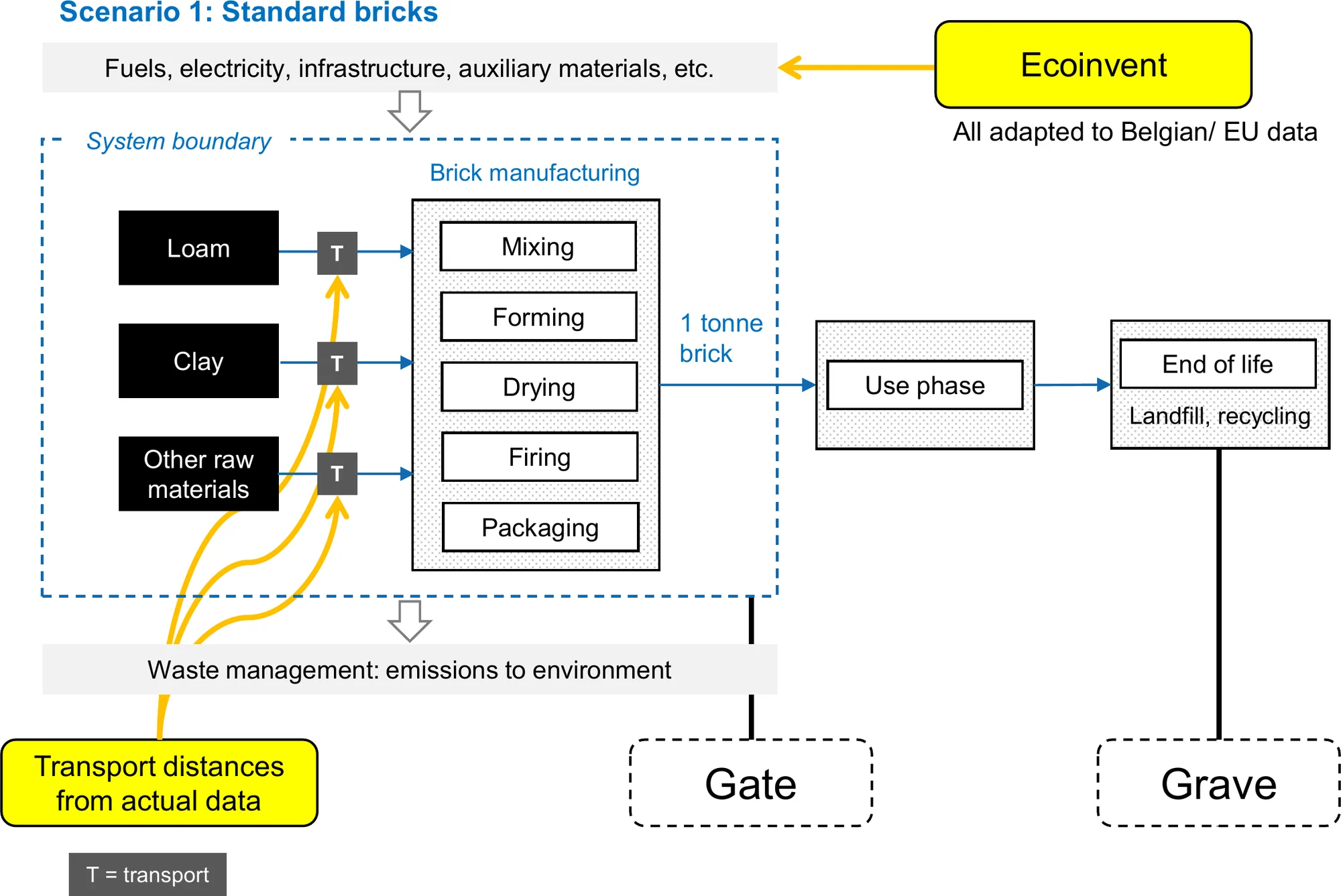
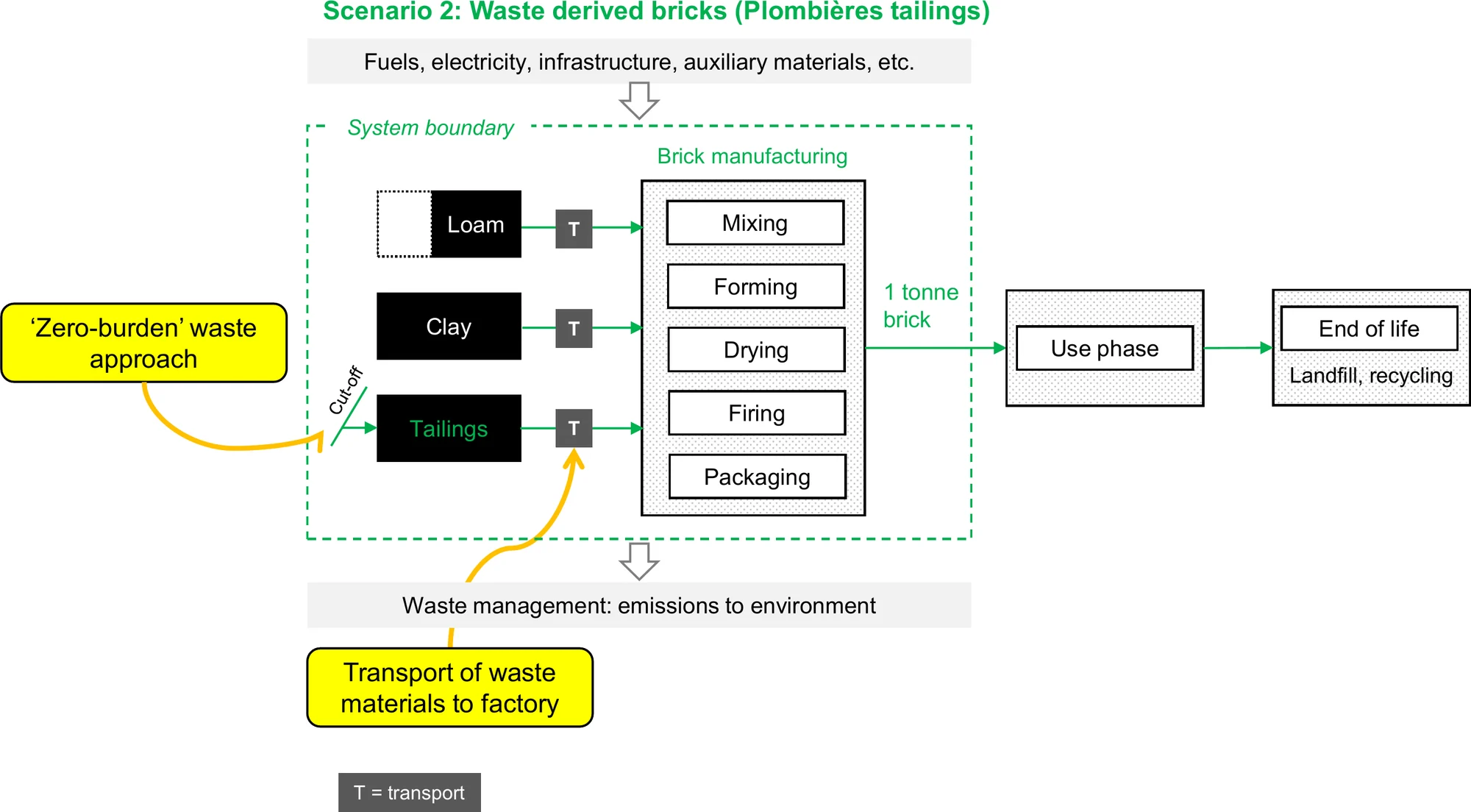
Cradle-to-gate LCA of 1 tonne of facing bricks, modelled in SimaPro 9.2 with Ecoinvent 3.6 and the EU Environmental Footprint 3.0 method. Both products meet the same technical and environmental requirements. Flowcharts: Adrianto, L.R. (2021), LCA exchange with Wienerberger.
Comparative impacts
- −0.5%
Climate change
- 0%
Ozone depletion
- −0.5%
Ionising radiation
- −4%
Photochemical ozone formation
- −11%
Particulate matter
- −13%
Human toxicity, non-cancer
- −26%
Human toxicity, cancer
- −6%
Acidification
- −19%
Eutrophication, freshwater
- −5%
Eutrophication, marine
- −6%
Eutrophication, terrestrial
- −14%
Ecotoxicity, freshwater
- −8%
Land use
- −9%
Water use
- −0.5%
Resource use, fossils
- −32%
Resource use, minerals and metals
- −7%
PEF endpoint single score
Reduction in impact versus standard bricks (Scenario 1 = 100%). Values read from Figure 5 of Veiga Simão et al. (2022), Journal of Cleaner Production 133118.
Contribution analysis
Energy and direct emissions dominate
Manufacturing energy and direct process emissions drive most midpoint indicators, so swapping raw materials alone cannot decarbonize brick production.
Raw materials drive toxicity and resource impacts
Extracting clay, loam and filler is the largest contributor to particulate matter, human and eco-toxicity, eutrophication and mineral depletion in the standard blend.
Tailings substitution cuts the raw-material burden
Replacing loam with Plombières tailings reduces raw-material-stage impacts by 1% to 15% depending on the category, with the largest gains in resource use, toxicity and eutrophication.
Transport adds a small, offsetting burden
Hauling tailings to the plant adds impacts, but they stay smaller than the savings from avoided primary extraction.
Contribution analysis from the December 2021 LCA exchange with Wienerberger, summarized qualitatively.
Key results
−10%
average impact reduction across EF 3.0 categories
−32%
resource use, minerals and metals
−18%
toxicity-related indicators
<1%
climate change benefit
−7%
PEF single score
Published results: Veiga Simão et al. (2022), Journal of Cleaner Production 133118.
More work.
- 2019 – 2022Mine Waste Value RecoveryFour-year PhD leading a 15-person team to model whether mine tailings value recovery is net-positive for the environment.
- 2014 – 2015Carbon Capture & Storage: Techno-Economic AnalysisTechno-economic modeling of carbon capture retrofits at two Indonesian coal plants, mapping the limits of economic viability.
- 2017 – 2018Waste Heat Recovery from Supermarkets for District HeatingSupermarket refrigeration heat recovery design for district heating networks, developed with Danfoss and Coop.